
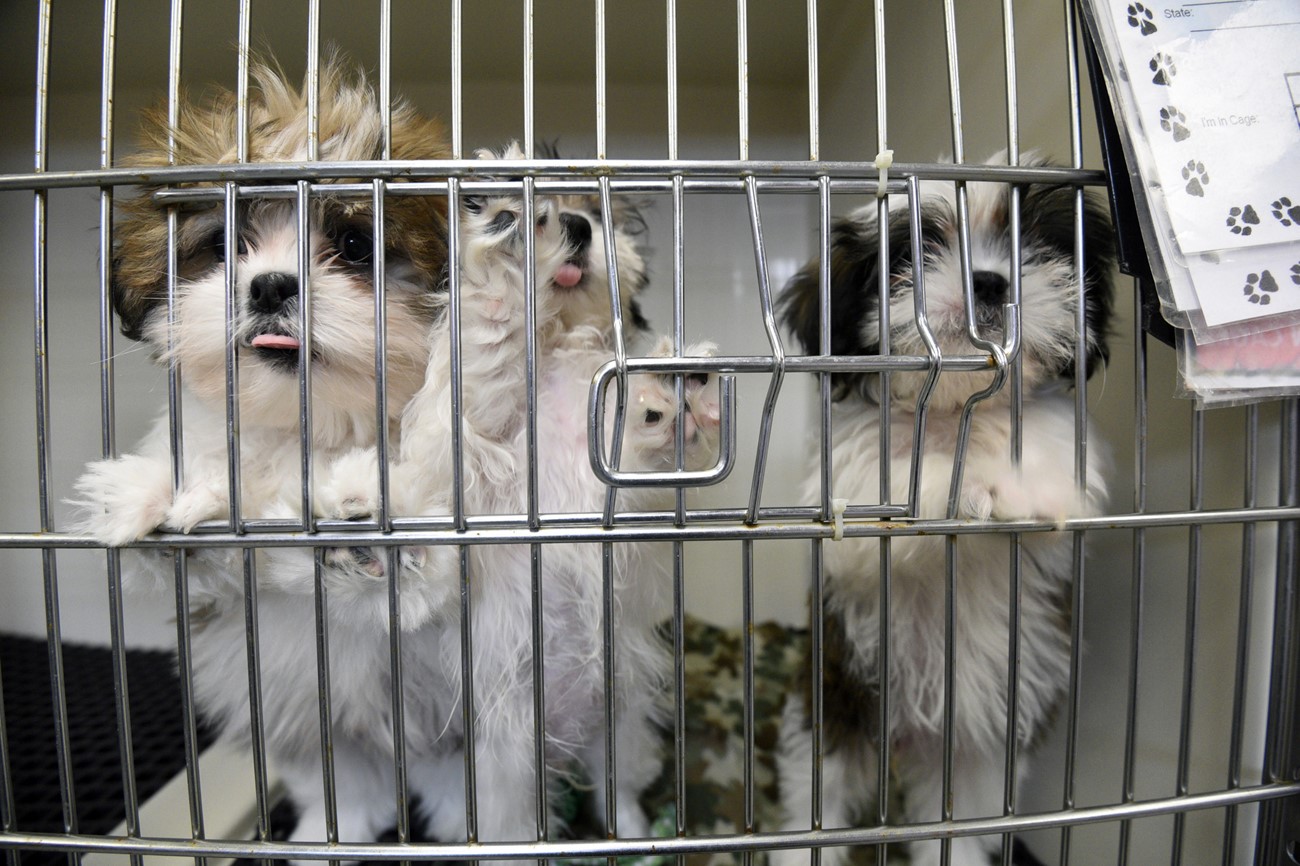
According to the ASPCA, in 2024 approximately 607,000 adoptable dogs and cats were euthanized in animal shelters in the United States simply because too many people give up their pets, and too few people adopt from shelters. 96,707 pets were killed in Texas shelters in 2019. Texas ranks as number two in the nation for animal shelter deaths. (For more animal statistics, go to World Animal Foundation’s website.) For every dog that is sold by a breeder, puppy mill or pet store, there is one in an animal shelter that had to be killed because it was not adopted. No one should buy an animal from a breeder or pet store. I regularly get calls from people who have purchased animals that turned out to be sick and dying or suffering from serious congenital conditions. Texas has consumer protection laws that can apply in these situations.
The Puppy Mill Horror
Unfortunately, most retail stores in Texas that sell puppies and kittens—including the biggest and best known pet stores—get them them from “puppy mills” in other states. The agony and suffering of animals in these cruel puppy mills is horrific. According to the ASPCA, puppy mill dogs are typically kept in extremely overcrowded, cramped, filthy cages, and the breeders maximize their profits by repeatedly breeding female dogs with little or no time to recover between litters and then killing them when they can no longer reproduce. The puppies are then trucked hundreds of miles to Texas in stacked cages and often arrive at pet stores infected with latent diseases ranging from parvovirus to pneumonia, and/or infested with parasites. The list of atrocities at puppy mills is too long for me to recount in this blog. An unsuspecting customer who falls in love with an adorable puppy in a retail pet store is never told that the healthy looking puppy that was wearned too early came from a puppy mill and may be diseased or suffering from congenital defects, which will cost thousands of dollars to treat. On top of pet stores selling sick and parasite-infested puppies, the fine print in most store’s sales contracts disclaims all implied warranties, limits the stores’ liability, and eliminates the customer’s ability to take legal action against the store. I regularly receive emails and telephone calls from heartbroken families who have purchased puppies from large pet stores and later had to incur thousands of dollars in vet bills and/or euthanize their puppy.
The Deceptive Trade Practices Act
The Texas Deceptive Trade Practices and Consumer Protection Act (DTPA) gives consumers a right to recover monetary compensation from a merchant whenever there has been:
• a breach of an implied or express warranty,
• an unconscionable action, or
• a false, misleading, or deceptive act or practice.
These legal claims are discussed below.
Breach of implied warranty of merchantability
Unless excluded or modified by contract, Texas law says that every sale of “goods” by a “merchant” carries an “implied warranty of merchantability”. Dogs and cats meet the legal definition of “goods.” The definition of “merchant” includes those who deal in those goods or who hold themselves out as having knowledge or skill peculiar to those goods. A dog breeder or pet store would meet this definition.
The implied warranty of merchantability means that the animal will “pass without objection in the trade under the contract description… and are fit for the ordinary purposes for which (the animal is) used.” When a dog breeder or pet store sells a sick animal or an animal with a congenital defect, it may be a breach of the implied warranty of merchantability. The buyer must be able to show that the animal was sick at the time of the sale. Sellers will often argue that the animal must have contracted the disease after the sale. For example, when a dog comes down with parvovirus, the question is whether the dog was infected with the virus at the time of the sale, or did it contract the virus after it left the seller. A veterinarian’s opinion about the incubation period and the onset of symptoms is always crucial in these cases.
Breach of implied warranty of fitness for a particular purpose
When a seller has reason to know any particular purpose for which an animal is required and that the buyer is relying the seller’s skill or judgment to select or furnish a suitable animal, there is an implied warranty that the animal will be fit for such purpose, unless this implied warranty is excluded or modified.
Implied warranties may be disclaimed
Implied warranties may be disclaimed by “expressions like ‘as is’, ‘with all faults,’ or other language which in common understanding calls the buyer’s attention to the exclusion of warranties and makes plain that there is no implied warranty.” If implied warranties are properly disclaimed, then the seller will not be liable for breaching them. Most retail pet stores disclaim all implied warranties because they sell sick, diseased, and parasite-infested dogs they have obtained from puppy mills and could not stay in business if they did not disclaim them.
Unconscionable action
Merchants who sell dogs and cats are also liable for “any unconscionable action or course of action.” Unconscionable action or course of action is “an act or practice which, to a consumer’s detriment, takes advantage of the lack of knowledge, ability, experience, or capacity of the consumer to a grossly unfair degree.”
Breach of an express warranty
Breeders and pet stores often have an express warranty in the contract that limits the buyer’s remedies. For example, animal sellers sometimes limit a buyer’s remedies when an animal is “defective” to getting a “replacement animal.” An express warranty will displace an implied one only if the implied warranty is “inconsistent” with the express warranty.
False, misleading, or deceptive acts or practices
In Texas a breeder or pet store is liable for “false, misleading, or deceptive acts or practices.” These include:
• representing that an animal has characteristics which it does not have,
• representing that an animal is “of a particular standard, quality, or grade, if (it is) of another;” and
• failing to disclose information concerning an animal “which was known at the time of the transaction if such failure to disclose such information was intended to induce the consumer into a transaction into which the consumer would not have entered had the information been disclosed.” For example, failing to disclose that a dog has been exposed to distemper or parvovirus might qualify.
Damages that may be recovered under the DTPA
A consumer who prevails in a DTPA claim is entitled to his or her “economic damages” or actual monetary loss. If the seller’s conduct was committed knowingly, a consumer may also recover damages for mental anguish and up to three times the amount of his or her economic damages. A prevailing consumer is also entitled to recover reasonable and necessary attorney’s fees.
Written notice of claim and the statute of limitations
A consumer is required to give the seller written notice of a DTPA claim at least 60 days before filing suit, with some exceptions. The statute of limitations for a lawsuit under the DTPA is two years.
Binding arbitration
Many retail pet stores have a clause in their sales contract that requires any complaint concerning a purchased animal to be submitted to “binding arbitration.” These binding arbitration clauses are designed to prevent consumers from filing a lawsuit or seeking justice through the court system. Binding arbitration can be expensive.
Join the Texas Humane Legislation Network
Everyone in Texas who owns or takes care of animals and cares about the laws that protect them should join the Texas Humane Legislation Network (www.thln.org.) This is a non-profit, grassroots organization that fights for animals in the Texas legislature. Most of the animal protection laws in Texas were passed because of THLN’s efforts. THLN has succeeded in getting many cities in Texas to prohibit the sale of animals within the city—including Dallas, Fort Worth, The Colony, San Antonio, Houston, College Station, and Waco. THLN will continue fighting to get a law passed that will stop the puppy mill pipeline. The more members THLN has, the more clout they have to get animal protection laws and ordinances passed.